
From scrapheap to strategy
As published in PV Magazine, December 2025
As many PV plants approach the midpoint in their typical lifespan of 25 to 35 years, the industry faces crucial decisions about what comes next. Much of the focus so far has been on managing modules, particularly on recovering their silicon and other materials. But the conversation must also extend to mounting structures. As the backbone of all solar plants, these structures represent a significant share of material use and a plant’s embodied carbon footprint. Everoze’s Kuba Gajewski explores reuse and end-of-life strategies for these structures and the practical barriers impeding their implementation.
While financial considerations have always driven discussions around end-of-life plans, sustainability factors are now inseparable from economics. ESG policies influence investment, permitting, and long-term planning, making end-of-life strategy a central concern.
In Europe, the Circular Economy Action Plan (CEAP, 2020) calls for a shift away from the traditional linear “take-make-dispose” economy toward circularity, where life extension is prioritized, followed by reuse or recycling. The Waste Framework Directive (WFD, 2018) supports this by setting recycling targets, including the requirement that 70% of construction and demolition waste be recycled or reused by 2020. These frameworks make it clear that the solar sector must plan more holistically for what happens after the first design life of its assets.
The most economical and sustainable option for PV mounting structures is life extension. This strategy requires minimal additional embodied carbon while maximizing the return on existing assets. If extending the full plant life is not feasible, the next-best approach is repowering (replacing modules, inverters, or other electrical components while reusing the mounting system.)
Damaged or obsolete components can be repurposed, recycled, or if unavoidable, disposed of. Decommissioning is the least sustainable strategy, but it sometimes becomes necessary, for example, if a permit or lease cannot be renewed, or if new module dimensions are incompatible with existing structures.
The embodied carbon savings from reuse are significant. According to the report “A brief guide to calculating embodied carbon,” published by the Institution of Structural Engineers, around 50% of whole-life embodied carbon is linked to the product stage for typical building structures. Since PV plants generate very low emissions during operation, the proportion of embodied carbon at the product stage is even higher. Sending components directly to scrap or landfill wastes these embodied savings and squanders opportunities for reuse.
Life extension
Biodiversity is another crucial sustainability factor. At first glance, decommissioning and restoring land to its natural state may seem best for ecosystems. This may be true if the site was originally a natural habitat. However, many PV plants were built on intensively managed farmland or brownfield land. During operation, habitats often regenerate, and new ecosystems form. Premature decommissioning risks disrupting these ecosystems, sometimes setting biodiversity back rather than improving it.
In the United Kingdom, Biodiversity Net Gain (BNG) legislation now requires that habitats are left in a measurably better state than before development. Life extension or repowering can therefore sustain or enhance biodiversity gains rather than erase them. This shifts the question from “returning land to its prior state” toward “ensuring long-term net benefits.”
Extending the life of PV mounting structures typically involves inspections, desk studies, and – where needed – testing and remedial works. Inspections identify visible defects, while design and integrity reviews verify compliance with evolving standards and assess long-term performance.
Where documentation is incomplete, testing may be required to confirm material properties or performance. In many cases, conservative assumptions are sufficient, but physical testing adds confidence. When weaknesses are detected, remedial works such as reapplying corrosion protection, strengthening with additional bracing, or upgrading connections can extend durability at relatively low cost compared to replacement.
Structural integrity
The primary driver of PV structure integrity is wind design. Life-extension assessments must revisit wind resistance, but encouragingly, if components were originally sized for extreme wind conditions, reinforcement is rarely needed. This is because PV structures are designed to endure rare but extreme conditions, and the probability of such events occurring does not increase with the age of the system. However, as some operational structures are under-dimensioned for code wind levels, it is essential to verify that components were properly specified, and that no history of wind-related damage exists.
Corrosion, by contrast, is a gradual, cumulative degradation. Soil corrosiveness varies widely and is hard to characterize accurately at design stage. Monitoring corrosion is even more challenging post-installation, as foundations are often inaccessible, buried underground. Protective measures like galvanization and coatings differ between projects based on cost and design conservatism, making foundation durability heavily dependent on initial specification. Superstructures, exposed to atmospheric conditions, are easier to inspect and maintain through targeted interventions.
Steel and aluminium pose distinct challenges for reuse or life extension. For steel, fatigue is often cited as a concern, but most fixed-tilt systems are not fatigue-critical. A desk-based screening is usually sufficient if resonance under wind actions is avoided (vibration in windy conditions). Trackers are more exposed to cyclic loading and warrant closer scrutiny. The UK Steel Construction Institute (SCI P427) advises caution with reclaimed steel in fatigue-sensitive applications, highlighting the need for careful assessment.
Aluminium is inherently more vulnerable to fatigue, particularly where stress concentrations coincide with resonant behaviour. Its extruded profiles are usually tailored to specific module sizes, limiting compatibility with newer products. Aluminium also dents or bends more easily during dismantling and handling, reducing its reuse potential. Consequently, steel can often be reused if integrity is confirmed, whereas aluminium is more often recycled than repurposed.
Finally, re-modelling introduces further complexity. Installing modules with new dimensions or weights alters loads and fixing requirements. In such cases, a comprehensive reassessment and sometimes partial redesign is required. Where a new service life is targeted, securing a responsible designer and warranty may be necessary to ensure fitness for purpose.

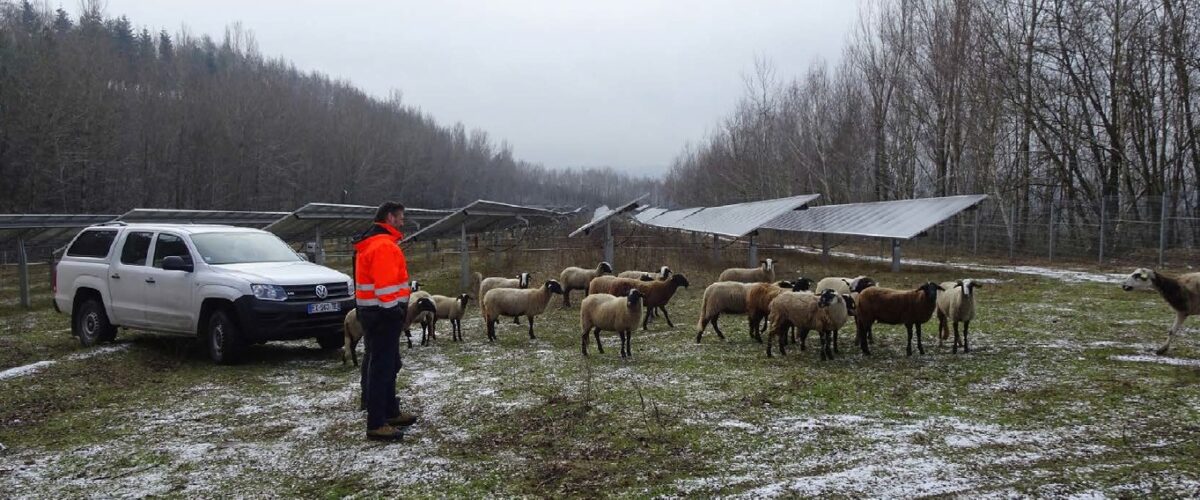
Solar panels on mounting structures offer opportunities for reuse and end-of-life sustainability.
Traceability and certification
Traceability and certification are critical to extending design life or reusing components. In principle, modern projects designed under ISO 9001 and EN 1090 (in Europe) should have robust documentation. In practice, record-keeping varies. Gaps in material certificates, manufacturing data, or maintenance logs introduce uncertainty and complicate recertification, particularly in less mature markets. Independent technical assessments can bridge gaps, providing reassurance to developers, investors, and insurers that extended operation is viable.
PV structures are less codified than traditional structural systems, especially in wind engineering. While understanding has advanced significantly over the last decade, variation between projects remains. In less mature markets, design practices sometimes lack the technical depth of more established regions, resulting in over- or under-designed systems. Even in mature markets, economic pressures have encouraged aggressive design assumptions and value engineering, sometimes at the expense of robustness.
As climate change intensifies extreme weather, these variations become even more critical. Climate risk assessments are increasingly required to verify that structures – whether extended, repurposed, or reused – can withstand more demanding conditions. For existing structures, this may mean strengthening. For reused components, it means designing the new installation to meet updated codes and standards.
Supply and demand
A major obstacle to widespread reuse is the mismatch between supply and demand. When components are available, new-build projects may not be ready to use them; when demand is high, reusable components may be scarce.
A useful precedent comes from the Netherlands, where the Nationale Bruggenbank serves as a centralized inventory of decommissioned bridge elements. These components are catalogued and reassigned to new infrastructure projects, reducing waste and material demand. A similar model could be created for PV mounting structures, linking decommissioning projects with new builds to create a functioning secondary market.
Extended Producer Responsibility (EPR) initiatives under the EU WFD could reinforce this. By assigning manufacturers accountability for recovery and reuse, EPR incentivizes design for disassembly and lifecycle recovery. Engineers and contractors can support this shift by incorporating salvaged materials into new designs, ideally through early-stage planning and bankability assessments.
Investor requirements
Stronger regulation and clearer investor expectations are needed to make end-of- life strategies mainstream. Current frameworks like CEAP and WFD encourage sustainability but stop short of mandating lifecycle planning during design. Strengthening these frameworks to require end-of-life considerations at permitting and design stages would embed reuse and recycling into industry norms.
Investors also have a pivotal role. They can drive developers to integrate reuse and recycling from the outset by requiring lifecycle strategies in contracts and financing agreements. Similar investor pressure has already raised standards for ESG reporting – the same could happen with end-of-life planning if it becomes a contractual requirement.
Lifecycle potential
PV mounting structures are well-positioned for sustainable end-of-life strategies. Their relatively short design life contrasts with the inherent durability of steel, provided it is protected against corrosion. Standardized profiles, robust documentation, and relatively young fleet age all create strong foundations for life extension and reuse.
Realizing this potential requires foresight and collaboration. Every stakeholder has a role to play, from developers and engineers to regulators, manufacturers, and investors. By embedding lifecycle thinking into both technical design and financial frameworks, the PV industry can reduce embodied carbon, minimize waste, and enhance biodiversity, all the while continuing to deliver affordable renewable energy at scale.


